
Gates County Release Date Meaning
The NCDAC public record uses the exact field name Projected Release Date. It is a calculation based on the sentence information and credits then recorded. Actual Release Date reports that a person left NCDAC prison custody. These fields must not be read as synonyms. A future projected date can change, while an actual date addresses a completed state-prison custody event.
Gates County adds a local custody problem. The Sheriff's Office does not publish a conventional jail roster and county planning records show that detainees are housed outside Gates. A county defendant's expected departure must be checked with the facility actually holding the person. A Gates court order may explain the authority for release, but the receiving jail holds the gate transaction. The state OPI system does not include local-jail-only bookings.
| Record | What it means | What it cannot prove alone |
|---|---|---|
| Projected Release Date | NCDAC's current calculated date for a sentenced state prisoner. | That the person has left prison. |
| Actual Release Date | The recorded end of the stated NCDAC prison custody period. | That all supervision or another authority's custody ended. |
| Bond or release order | The court basis that may permit a county detainee to leave. | The precise jail gate time or absence of another hold. |
| Transfer movement | A move to another institution or authority. | Community release. |
Search Gates County Release Dates
Begin with custody type, not a name search on every portal. For an NCDAC prisoner, open the Offender Public Information search. Choose All for a broad historical search or the current status that fits the inquiry. An offender number is the strongest key. Otherwise, combine name with date of birth, age range, and conviction details to avoid a false match.
For a Gates arrest, call the Sheriff's Office and ask which outside jail received the person. Then ask that jail for its own booking, custody, and release information. A pretrial detainee usually has no computed sentence-release date. Bond, judicial action, disposition, credit, and another hold can all decide whether and when the person leaves.
- Identify county jail, NCDAC prison, federal, or immigration custody. Do not assume Gates County operates the jail that holds the person.
- For NCDAC custody, search OPI and confirm identity by offender number, birth information, and offense details.
- Read Inmate Status, Projected Release Date, sentence terms, movements, and any supervision fields together.
- For an outside county jail, contact that facility and review the Gates court judgment or release order.
- Recheck near the date, register for a custody alert, and confirm the actual event with the jail or NCDAC.
The official NCDAC search form shows the status and identity fields used for state cases.
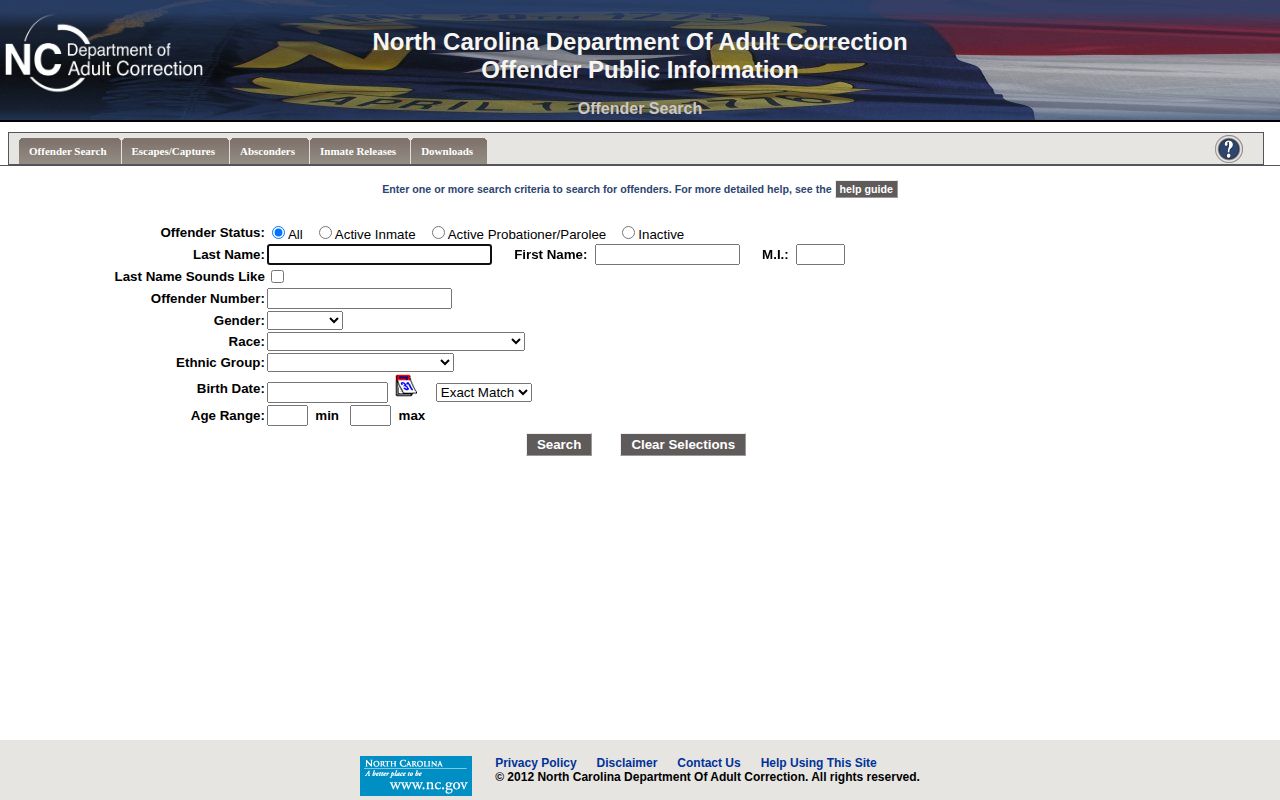
This statewide record can resolve prison custody and supervision, but it cannot replace the outside jail's record for a Gates County local booking.
For a named-person custody trail rather than a date calculation, use the Gates County released inmate lookup. Note: No OPI result does not prove release because local-jail-only bookings are outside that state prison database.
North Carolina Release Date Rules
Offense date matters. Under Fair Sentencing for crimes from July 1, 1981 through September 30, 1994, a person may be eligible for parole. NCDAC describes good time under that system as one day for each day of good behavior, subject to loss for discipline, with gain time also possible for work or program participation. Older statutes, offense-specific rules, and the full sentence record control any individual calculation.
Structured Sentencing applies to felony crimes committed on or after October 1, 1994. NCDAC says there is no parole under that framework except for the separate misdemeanor DWI system. A prisoner serves the full judicial minimum, with eligible jail credit counting toward it. Earned time from eligible work or full-time programs can reduce the maximum toward the minimum. It cannot reduce the custodial term below that minimum.
G.S. 15A-1340.13(d) provides the structured-sentencing floor. G.S. 148-13 authorizes NCDAC rules for earning and forfeiting credit and calls for distribution of those rules to local jail administrators for sentenced jail prisoners. A sentenced Gates County jail term therefore still needs the judgment, jail credit record, and responsible jail's application of the rules.
- Good time
- A credit associated with behavior under the applicable correctional rules.
- Earned time
- A credit tied to eligible work or program activity and subject to governing limits.
- Judicial minimum
- The lower term set in a structured sentence, which forms the custodial floor.
- Jail credit
- Qualified prior confinement credited toward the sentence when legally applicable.
Gates County Eighty-Five Percent Rule
NCDAC's official explanation says Structured Sentencing requires at least 100 percent of the minimum and 85 percent of the maximum before felony offenders enter post-release supervision. That statement is not a universal instruction to multiply every sentence by 0.85. The judicial minimum controls the earliest custodial floor. Sentence-class ranges build a supervision period into the maximum, and earned-time treatment depends on the person's record.
Under G.S. 15A-1368.2, a post-release date generally derives from the maximum less the applicable supervision period, then accounts for earned time. The research identifies commonly stated periods of 12 months for Class B1 through E and nine months for Class F through I, with a different 60-month rule for specified sex-offense maximums. Current law, sentence class, and sentence facts must be confirmed before applying a period.
The North Carolina Post-Release Supervision and Parole Commission administers supervision. It does not select a structured-sentencing prison-release date. Confusing those roles can turn a projected date into an unsupported parole claim.
Why Gates County Dates Change
A projected release date can move when an input changes. OPI should be rechecked close to the expected event, and the judgment and credit record should be reviewed when the date seems inconsistent. The public field is a useful snapshot, not a guarantee.
| Factor | Possible effect | Best record to check |
|---|---|---|
| Jail credit correction | Changes the time already credited toward the sentence. | Judgment, commitment, and credit record. |
| Concurrent or consecutive terms | Changes sentence aggregation and the controlling end date. | Sentence history and each judgment. |
| Disciplinary loss or restoration | Reduces or restores applicable credit. | NCDAC calculation and authorized records. |
| Work or program assignment | May affect eligible earned time. | NCDAC sentence calculation. |
| Appeal or later court order | Can alter the conviction, term, or credit. | Gates court file and revised judgment. |
| Detainer or other hold | May lead to transfer or continued custody elsewhere. | Holding agency and receiving authority. |
A transfer does not equal an early release. It means one custodian's control ended while another may have begun. This is especially important after a Gates County arrest because outside housing is routine rather than exceptional.
Note: A court disposition explains the legal result, while the jail or prison records the actual custody movement.
Gates County Pretrial Release Dates
Pretrial detention is governed by current orders and conditions, not by a sentence calculation. Bond may permit release once its terms are met. A judge may change conditions, dismiss a charge, impose a sentence, or issue another order. Time credit can matter if a sentence follows. An unrelated hold may prevent community release even after the Gates case would otherwise allow departure.
Use public case events to understand the legal basis, but ask the receiving jail whether the person actually left and at what time. Gates County's sheriff can help identify the outside facility. The receiving jail may hold the jail-management release entry, while Gates retains arrest, commitment, and transport records. When the custodianship is split, separate requests are more accurate than asking one office to reconstruct the whole chain.
Gates County State Release Index
NCDAC also operates a separate monthly Inmate Release Search. It accepts a surname or a release county with year and month. Gates is selectable as release county code 37. Result columns include offender number, name, Release Date, primary offense and qualifier, and Type Of Release. A result can lead to the detailed OPI record where custody, sentence, movement, and supervision fields can be compared.
This index covers NCDAC state inmates. It is not a Gates County jail release list and is not a source for a future projected date. During research, the visible year control covered 2024 through 2026, but that screen does not establish a permanent retention period. Historical OPI records reach much farther back, so use the person record when the monthly screen does not cover the needed period.
A Gates release-county label should also be checked against the individual detail before describing the person's location. Release county, institution, supervision office, and arrest county may refer to different parts of the record. The monthly result confirms a reported state release row, while the detail explains the state custody term.
Note: The monthly NCDAC index confirms a reported state release row, not a projected date or a Gates jail departure.
Request Gates County Date Records
If public screens do not resolve a date, request the specific existing record from the proper custodian. Gates County may hold a commitment, transport destination, court-linked paperwork, or an administrative release or transfer entry. The receiving jail may hold the jail-management timestamp. NCDAC's public-record portal can provide public sentence, time-served, admission, and release-date information for state cases, but it cannot provide a Gates local-jail record.
Give the person's identifying details, offender or booking number, relevant term, and the exact fields requested. Ask for native electronic copies. NCDAC says simple requests may take days while complex or redaction-heavy requests can take weeks or months. That timing is a records-response estimate, not a change in the prisoner's projected release date.
Confirm Gates County Release Events
NC SAVAN links North Carolina jails and Adult Correction and can send an alert when its source reports a custody event. Search the correct person and agency, verify identity, and register for available phone, text, or email notice. A transfer alert requires a new custody check. It does not prove community release.
The Gates County VINELink Release Check covers registration details and the phone PIN. Treat the alert as supplemental. For state prison, confirm with NCDAC status and Actual Release Date. For a county booking, confirm with the outside receiving jail. For a court-driven release, compare the jail event with the Gates case order.
The final answer to “when did release occur” is an affirmative event from the agency that held the person. Roster disappearance, an old projected date, or a no-result screen cannot supply that fact alone.